Leon Hartmann · 23 October 2026
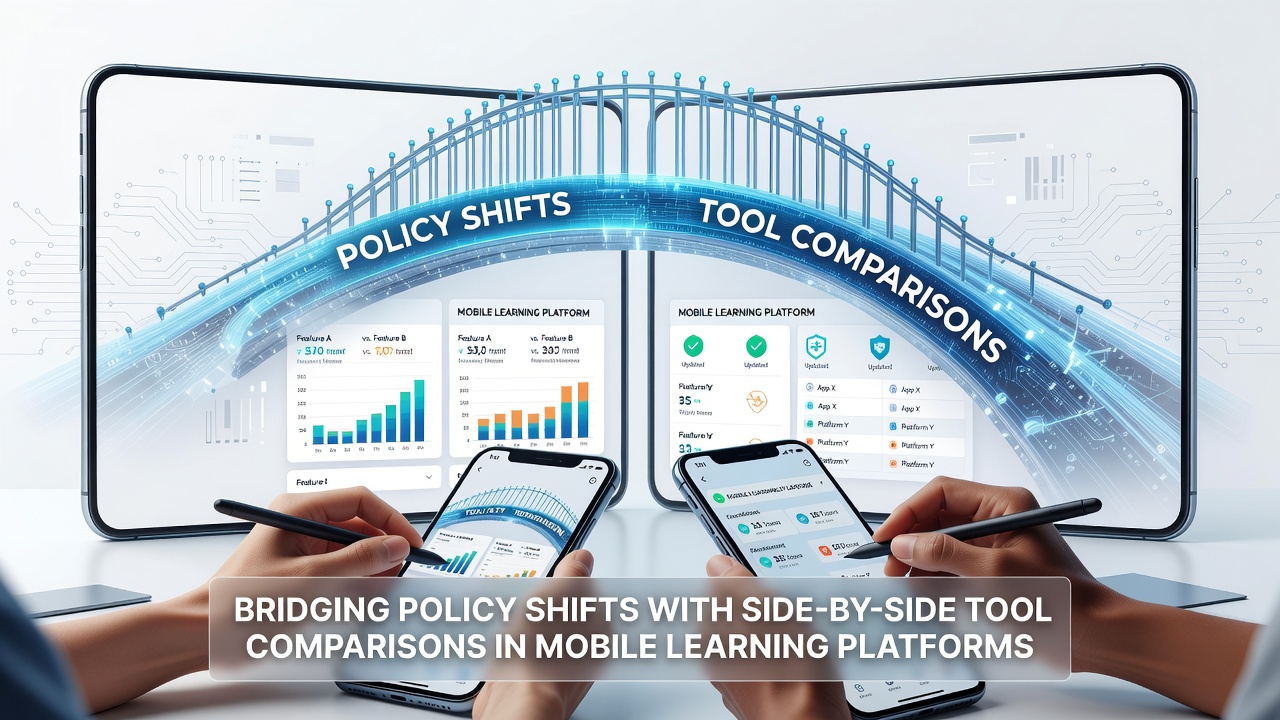
Bridging Policy Shifts With Side-by-Side Tool Comparisons in Mobile Learning Platforms
Policy adjustments in education technology continue to reshape mobile learning platforms throughout 2026, and side-by-side tool comparisons have emerged as a practical method for institutions to align their choices with new requirements. In October 2026 several regulatory frameworks across multiple regions updated guidelines on data privacy, accessibility standards, and content delivery in digital education environments. These changes affect how platforms manage user information and deliver interactive modules, while comparisons between tools allow administrators to evaluate compliance features directly.
Recent Policy Developments in Digital Education
European Commission directives on digital education accessibility took effect in early 2026, requiring mobile platforms to incorporate enhanced screen reader support and multilingual interfaces by October. Data from the commission shows that over 60 percent of member states reported increased adoption of compliant applications during the preceding quarter. Meanwhile the Australian Department of Education released updated standards for mobile content security that emphasize encryption protocols for student records. Observers note that these parallel updates create overlapping demands for developers who serve international users.
Researchers at the OECD documented similar patterns in North American contexts, where state-level policies in the United States introduced stricter requirements for third-party data sharing in educational apps. Figures reveal that platforms failing to meet these benchmarks faced restricted access in several school districts by mid-2026. Side-by-side evaluations help decision makers identify which tools already satisfy multiple regional mandates without requiring extensive custom development.
Mechanics of Side-by-Side Tool Comparisons
Side-by-side comparisons function through structured matrices that list features such as integration capabilities, user analytics, and compliance certifications across competing platforms. Institutions typically select criteria drawn from current policy language, then populate the matrix with verified specifications from each vendor. This process highlights differences in real time, allowing teams to see how one platform handles automated consent management while another emphasizes offline accessibility modes.
Take one case where a Canadian university system applied this method in September 2026. Administrators compared three major mobile learning solutions on metrics including data residency options and adaptive assessment tools. The resulting table demonstrated clear variances in encryption standards, which aligned directly with new provincial regulations scheduled for implementation later that year. Those who conducted the review reported faster procurement cycles because gaps appeared immediately rather than during later audits.

Platform Examples and Feature Alignments
Common platforms such as Canvas Mobile, Moodle app variants, and Blackboard Learn incorporate policy-responsive features that comparisons bring into focus. Canvas provides built-in accessibility checkers that flag content against WCAG 2.2 guidelines, while Moodle emphasizes open-source customization for regional data storage rules. Blackboard integrates analytics dashboards that track user consent flows, a function that addresses specific requirements outlined in recent EU updates. When placed side by side these distinctions become actionable for procurement teams seeking comprehensive coverage.
Studies conducted by university research groups indicate that institutions using structured comparisons reduced implementation delays by an average of three weeks in 2026. The method also surfaces hidden costs, such as additional licensing fees for compliance modules that some vendors charge separately. Data indicates platforms with transparent feature documentation perform better in these evaluations because evaluators spend less time requesting clarifications from support teams.
Implementation Across Educational Sectors
K-12 districts in multiple countries adopted side-by-side frameworks after policy announcements in the spring of 2026. Teachers and IT staff collaborated on matrices that weighed factors like parental notification systems and device compatibility. One district in New Zealand reported that the approach clarified which platform met both national curriculum standards and updated privacy laws without additional middleware. Higher education entities followed similar patterns, often extending comparisons to include student feedback modules that policies now encourage for continuous improvement tracking.
Industry reports from organizations like the International Society for Technology in Education highlight that these comparison practices scale across different institutional sizes. Smaller colleges benefit from simplified versions of the matrix that focus on core compliance items, whereas larger universities incorporate deeper technical benchmarks such as API response times under high user loads. The shared outcome remains consistent: policy shifts become bridgeable when tool attributes receive systematic review.
Conclusion
Side-by-side tool comparisons continue to serve as a bridge between evolving policy landscapes and practical platform selection in mobile learning. As October 2026 progressed, institutions across regions applied these methods to meet overlapping standards on privacy, accessibility, and content delivery. Evidence from regulatory bodies and academic studies shows measurable improvements in alignment speed and reduced compliance risks when evaluations proceed through structured matrices rather than isolated assessments. This pattern supports ongoing adaptation as policies develop further in subsequent periods.